
Hello friends,
I did not write during the past month. Life became a little too intense —You didn’t tell me that raising two daughters is so much work. — but I’m happy to be back.
This month’s newsletter continues a sub-series I call “SHOW ME THE MONEY,” looking at Israeli banknotes as a way to understand Israeli society and culture. In a previous newsletter, I wrote about the 200 shekel bill featuring Natan Alterman, one of the central literary voices of the pre-state Jewish community and the early years of Israel. If you missed it, here is the article:
Show Me the Money – Natan Alterman and the 200 Shekel Bill
In 2017, the Bank of Israel released a new series of banknotes that Israelis still use today. The 100 shekel bill features the portrait of Leah Goldberg. The four bills in the series are often called “the writers’ bills.” If you look closely, each bill includes an open book as part of the design, emphasizing literature and culture.
You can learn a surprising amount about a country by looking at its money.
Israel’s earliest banknotes were filled with pioneers, farmers, soldiers, tractors, fields, and symbols of collective national effort. Later came portraits of major Zionist leaders like Theodor Herzl and Ze’ev Jabotinsky. But this newer series reflects a different Israel — a more mature and perhaps more “normal” society, one confident enough to place poets and culture at the center of its national identity.
Leah Goldberg is a fascinating choice for such a symbol.
She was born in 1911 in East Prussia, then part of Germany. The region later became Lithuanian territory and today belongs to Russia. Her family moved to Kaunas, Lithuania, during her childhood. She studied at a Hebrew Gymnasium and later earned a doctorate in Semitic languages in Germany. She immigrated to Mandatory Palestine in 1935 and quickly became one of the most important voices in Hebrew culture.
Goldberg did almost everything: poetry, children’s books, literary criticism, theater, translation, journalism, and academia. She taught Hebrew literature at the Hebrew University of Jerusalem and helped establish the department of comparative literature there.
Today, she is probably the most beloved writer in modern Hebrew culture, although much of her fame came only after her death in 1970.
There are two major reasons for this.
First, many of her poems were turned into songs that became classics of Israeli music. In Israel, poetry and music often merge together, and Goldberg’s words became part of everyday life.
Second, while many writers of her generation focused on nationalism, pioneering, war, sacrifice, and the collective experience, Goldberg often wrote about the individual: loneliness, love, nature, longing, memory, and quiet inner emotions. As Israeli society changed over the decades, her writing aged remarkably well. Nationalist poetry sometimes feels tied to a specific historical moment. Goldberg’s poetry feels timeless.
Ironically, during her own lifetime she was never fully embraced by the literary establishment. Maybe because she was one of the few women in that world. Maybe because she never married. Maybe because she was considered eccentric. Or perhaps because her deeply personal writing did not fit the dominant heroic Zionist tone of her generation.
But students adored her. Readers loved her. And over time, Israeli culture caught up with her.
Today, her poems and children’s books are deeply woven into Israeli identity.
Looking at the 100 shekel bill itself, the design tries to combine Goldberg’s portrait with the emotional world of her writing: poetry, childhood, memory, and nature. To me, the bill itself feels almost like a small piece of art.


On the front side appears Goldberg’s portrait surrounded by delicate white flowers. Nature was one of the themes she returned to again and again throughout her poetry.
On the reverse side is an illustration of a doe, inspired by her famous children’s song “What Do the Does Do at Night?” Alongside it appears a line from her poem “White Days”:
“White days, long as the rays of the summer sun…”
The entire bill is designed in warm shades of brown and gold, creating an unusual feeling of softness and light.
This is not a banknote celebrating power or military victory.
It is a banknote celebrating sensitivity.
I highly recommend listening to a few of her songs and poems.
“What Do the Does Do at Night?”
YouTube – What Do the Does Do at Night?
“White Days” (with English translation at the top)
YouTube – White Days
White days, long, like the rays of the summer sun.
Serene loneliness is great on the river.
Windows wide open to the silent blue.
The bridges are straight and tall between yesterday and tomorrow.
It’s so easy to carry on with your silence, white and empty days
For my eyes have learned to smile and have ceased…
…to hasten the race of the hands on the clock.
The bridges are straight and tall between yesterday and tomorrow.
My heart has become accustomed to itself, and patiently counts its beats.
And to the sweet rhythm it molds, yields and calms down.
Like a baby singing his lullaby when he closes his eyes,
As the exhausted mother ceases from her singing and begins her sleep.
Quiet poetry. Gentle poetry. In some ways, very un-Israeli. And perhaps therefore, deeply Israeli.
Here are three different famous examples from her work:
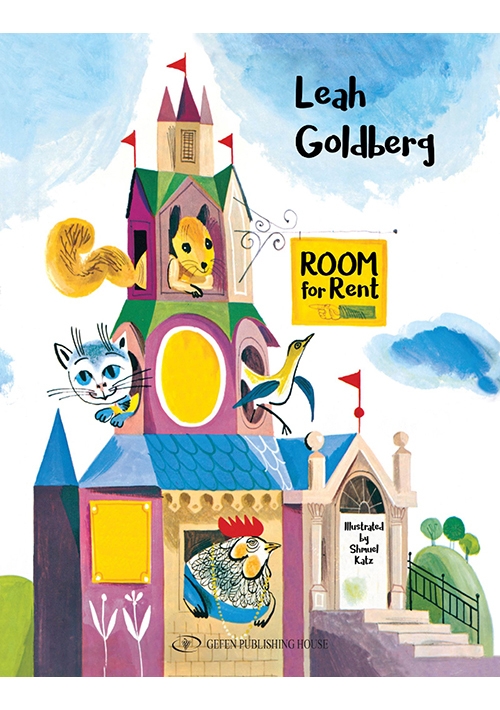
One of Goldberg’s most famous children’s books is A Flat for Rent, available today in English translation as well. The story, written in rhyming verse and illustrated by Shmuel Katz, tells the story of a five-story apartment building whose top-floor tenant — a mouse — suddenly leaves. The neighbors themselves (not a realtor 😀) put up a sign saying “Apartment for Rent.”
Different animals come to see the apartment, but each refuses because of prejudice against another neighbor. The climax comes when a pig refuses to live near a black cat. The neighbors reject him as well, because they refuse to tolerate intolerance.
Finally, a dove arrives. The apartment itself is not perfect, she says, but the neighbors are wonderful.
The book was published in 1959 during Israel’s massive immigration waves of the 1950s. In just a few years, Israel’s population nearly tripled, from around 600,000 before independence to about 1.8 million by the early 1950s. The young country became an enormous cultural experiment — almost a modern Tower of Babel.
The story gently challenges stereotypes and prejudice while emphasizing the shared home being built by immigrants arriving from all over.
The book became so iconic that even today, Israel’s government company for long-term public housing uses the same name and logo.
Another famous poem is “From the Songs of My Beloved Land,” considered by many Israelis one of the ultimate expressions of love for Israel.
The funny part? Goldberg actually wrote it about Kaunas, Lithuania, not Israel. But apparently, emotional truth matters more than geography. One redheaded politician from Washington has already taught the world that facts are sometimes negotiable anyway.
Here is a beautiful version with automatic English subtitles:
YouTube – From the Songs of My Beloved Land
From the Songs of My Beloved Land / Leah Goldberg
My homeland – land of beauty and poverty.
The queen has no home, the king has no crown.
There are seven spring days in the year And cold and rain all the rest.
But for seven days the roses bloom,
And for seven days the dew drops shine,
And for seven days, windows are open.
And all your poor folk stand in the street
And lift their pale faces toward the good light,
And all your poor folk are happy.
My homeland, land of beauty and poverty,
The queen has no home, the king has no crown.
There are seven holy days in the year And hunger and toil all the rest.
But for seven days the candles are blessed,
And for seven days the tables are set, And for seven days, hearts are open.
And all your poor folk stand in prayer, Your sons and daughters are grooms and brides,
And all your poor folk are brethren.
Another deeply moving song is “Trees” (“Ilanot”), which speaks about immigration, homesickness, and longing for the old country — in Goldberg’s case, Lithuania.
This song affects me personally. Sometimes, even in my own country, I feel like a stranger myself. I would love to give this song to every new immigrant arriving in Israel as encouragement: hold on. One day, this country will smile back at you.
In the 1990s, the Israeli-American singer Noa (Ahinoam Nini) added an additional verse to the song.
People often ask how someone ends up on a banknote. Is there simply a committee somewhere making decisions? Or is there usually somebody pushing behind the scenes?
In this case, I actually know part of the story personally.
My cousin’s husband, Yair, is a veteran lawyer in Tel Aviv and the executor of Leah Goldberg’s estate. He received this role through Goldberg’s mother, who had been a close friend — going all the way back to Kaunas — of Yair’s mother. Since Leah Goldberg never had children of her own, young Yair (today 82 years old) even received a personal dedication in one of her books.
Yair became one of the major forces behind Goldberg’s renewed cultural prominence in recent decades, including the campaign for her appearance on the 100 shekel bill. He also continues approving new musical adaptations, theater productions, and contemporary uses of her work, helping introduce Goldberg to younger generations.
Meanwhile, over here in Israel, things remain unclear regarding Iran. I would honestly be curious whether things seem any clearer from the other side of the Atlantic, because from here, they certainly do not.
I cannot tell whether we are heading toward some kind of agreement or toward escalation. But the uncertainty itself is terrible for tourism, and currently, there are almost no tourists at all.
Still, I’m grateful for this newsletter as a way to stay connected. As always, I would love to hear your thoughts, questions, reactions, or even simply schedule a Zoom conversation about what is happening in Israel right now.
Greetings from Jerusalem,
Hilik