
To mark the start of the civil year 2026, I decided to dedicate my monthly article to the Hebrew calendar.
Tourism is slowly coming back, and I was guiding again at the end of December. On December 31st, 2025, I spent the day with a Christian family from the Baptist community. I explained that, on the one hand, New Year’s Eve is not an official holiday in Israel. Everyone celebrates, drinks, counts down at midnight—and the next morning, most people go straight back to work.
Most Israelis live according to the “regular” (Gregorian) calendar and don’t actually know today’s Hebrew date. But—and this is the interesting part—all holidays, school breaks, and national observances in Israel are set according to the Hebrew calendar.
Confusing? Absolutely.
But that’s what happens when you want to be both a Jewish state (Hebrew calendar) and a modern state (Gregorian calendar).
I’m Jewish, and Jews love answering questions with… more questions
So here’s one:
Why do Jews outside of Israel celebrate every holiday twice—two Passover Seders, two holiday evenings—while in Israel we celebrate only once?
The answer is right here.
The Hebrew calendar is based on both the sun and the moon. Until the destruction of the Second Temple, two witnesses had to arrive in Jerusalem and testify that they had seen the new moon. Only then was the new month declared, and messages were sent to Jewish communities outside the Land of Israel.
So why two days of holidays in the Diaspora?
Because communities far away had to wait for confirmation of the new month, sent using signal fires on mountaintops. Since they were never fully sure whether a month had 29 or 30 days, they celebrated each holiday for two days—just to be safe. One of the mountaintops used for these signals was Safed, mentioned in the Mishnah in this context.
Around the mid–4th century CE, about 300 years after the Temple’s destruction, Hillel (yes—related to that Hillel, the one many American campus groups are named after) fixed the Hebrew calendar. Thanks to that, today we can calculate the exact date of Rosh Hashanah even 200 years into the future.
In the Hebrew calendar, a day begins in the evening, not the morning. This idea comes from Genesis: “And there was evening, and there was morning.”
This often causes confusion—Friday night is actually already Shabbat.
The names of the Hebrew months came with the Jews returning from the Babylonian exile (516 BCE, following Cyrus’s declaration). Each month has meaning:
Nisan relates to renewal and first fruits,
Iyar is connected to light and blossoming.
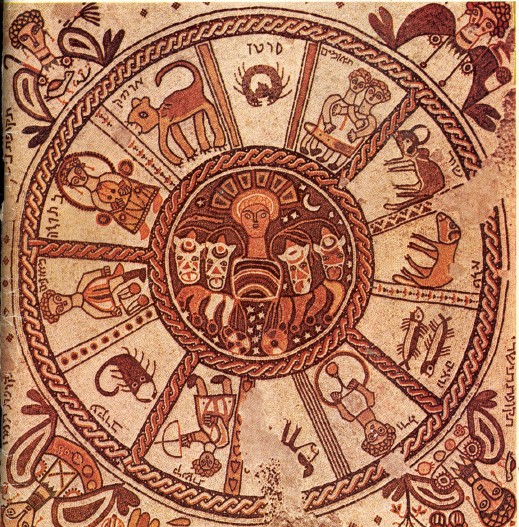
A zodiac wheel with the Greek god Helios at the center. The zodiac signs, seasons, and Hebrew month names appear in standardized Hebrew, aligned with the agricultural calendar of the Land of Israel (Beit Alfa, 5th–6th centuries CE).
The Hebrew calendar is truly synchronized only in Israel. Jewish holidays here match the agricultural seasons. Passover is the holiday of spring—and spring always arrives on time. Outside Israel, Jews sometimes celebrate the “Festival of Spring” while it’s still snowing. This even helps explain cultural differences:
Ashkenazi Jews (from Europe) and Sephardi or Middle Eastern Jews experienced very different climates. Take Sukkot, for example. One of the commandments is to sit in the sukkah.
For Ashkenazi Jews, “sit” usually means eating one meal—it’s already cold.
For Moroccan or Iraqi Jews, “sit” means eating, sleeping, and practically living there—the weather is warm and pleasant.
As a Jew living in Israel, I truly love how the calendar fits the seasons. The Hebrew calendar is one of the defining features of a Jewish state.
You know the joke: Two Jews, three opinions.
And yet—despite all disagreements—on the subject of time, the Jewish people share one calendar.
Secular Jews in Tel Aviv, ultra-Orthodox Jews in Brooklyn, Reform Jews in California, and Conservative Jews in Britain all celebrate the holidays at the same time.
When calendars differ, cultures eventually split. Christmas, for example, is celebrated on different dates by Catholic–Protestant communities (Gregorian calendar) and Orthodox communities (Julian calendar).
This also happened in Jewish history. During the Second Temple period, there were three major groups: Sadducees, Pharisees, and Essenes. The Essenes followed a different calendar—and because they didn’t celebrate holidays with the rest of the people, the group eventually disappeared after the Great Jewish Revolt.
In conclusion:
The Hebrew calendar is not just a way of measuring time. It expresses Jewish identity throughout the year and reflects a deep connection between time and place—the Land of Israel.
As always, I’m happy to talk about Israel and Judaism, sports and politics.
If you have friends thinking about visiting Israel, I’d be grateful if you recommend me.
Wishing you a successful and joyful 2026.
May we soon hear good news for the hostage Rani Gvilli and Neighbors to the East
With love,
Hilik