
But historically speaking, that’s not the real reason.So how did most Israelis end up with the “kindergarten version” of Hanukkah? Did we forget the real story… or never really learn it in the first place?
If you haven’t read my previous article about the Jewish origins of Hanukkah, you can find it here:
https://docs.google.com/document/d/1MsfJ79XqMN1SsRhKAHQwkUoi_76tifSGWTdaziOF8Q8/edit?tab=t.0
In many ways, this short piece is its continuation — this time focusing on the Christian Festival of Light, its origins, and its traditions.
________________________________
Coincidence — or Shared Pagan Roots?
Is it just a coincidence that Jewish Hanukkah and Christian Christmas fall at the same time of year?
Or do they share common pagan ancestors?
The answer is probably yes — and it all begins with agriculture, darkness, and humanity’s fear of the unknown.
The shortest day of the year, the winter solstice, falls on December 21 today (in the ancient world, it was marked around December 25). Until that moment, days grew shorter and darker. After it, light returns slowly.
Ancient people, who feared darkness and loved light, celebrated this turning point with festivals marking one powerful message:
The world is not ending — and neither are we.
The Greeks were early adopters of these celebrations, but the Romans took them to the next level. They celebrated Saturnalia (December 17–26), honoring Saturn, the god of agriculture, followed by Kalendae at the beginning of January. Together, these festivals lasted over two weeks and included feasting, gifts, lights, and role reversals.
On top of these pagan celebrations, two new religious holidays were born — one Jewish, one Christian.
________________________________
Christmas: A Christian Holiday with Ancient Roots
Not all Christians celebrate Christmas on December 25. Eastern Orthodox and Armenian churches, for example, celebrate on January 7.
Most scholars believe that Christmas was officially established around the year 350 CE, under Emperor Constantine, a pagan Roman ruler who converted to Christianity and forever changed world history.
As Christianity replaced paganism, it absorbed familiar symbols and traditions. December 25 was declared the birthday of Jesus of Nazareth. If Jesus was Jewish (which he was), his circumcision — eight days later — would fall on January 1.
The Christmas tree comes from Germany. Evergreen trees stay green through winter and symbolize life, continuity, and hope beyond the cold season.
The star atop the tree refers to the Star of Bethlehem mentioned in the New Testament, which guided the Three Wise Men to find the “King of the Jews.”
________________________________
Santa Claus, Coca-Cola, and Capitalism
Santa Claus — the jolly winter gift-giver — arrived in America with Dutch settlers who founded New Amsterdam (today’s New York).
Santa is based on Saint Nicholas, who lived in Asia Minor and was canonized in 1087, becoming the patron saint of children.
Contrary to popular belief, Santa’s red and white colors existed long before Coca-Cola.
Red symbolizes the blood of Jesus; white represents snow, winter, and purity.
And Christmas decorations?
These are modern department-store inventions in England and the U.S., designed to encourage holiday shopping.
________________________________
Fun Fact: Jews Wrote the Soundtrack of Christmas
Here’s a delightful twist: many classic American Christmas songs were written by Jewish composers.
Well… people need to make a living — and Passover songs don’t exactly pay the rent.
Irving Berlin (born Israel Baline) wrote “White Christmas.”
Jay Livingston (born Jacob Harold Levison) co-wrote “Silver Bells.”
You can read more about Jewish contributions to Christmas music here:
https://www.anumuseum.org.il/blog/christmas-songs/
(Source: ANU – Museum of the Jewish People, Tel Aviv University)
________________________________
Belief, Archaeology, and Tradition
I need to distinguish between faith, archaeology, and tradition personally.
The purpose of this article is not to offend or diminish Christian believers, but to expand knowledge about the origins and traditions of Christmas.
I observe the Passover Seder every year, even though there is no scientific or archaeological evidence for the Exodus from Egypt. I’m not celebrating “historical truth” — I’m celebrating a narrative and values: freedom, renewal, spring, and family.
Faith works much like banking:
If enough people believe in it, it becomes real.
The same applies to Christmas. For me, if millions believe this is the birthday of Jesus of Nazareth, then it becomes true in the cultural and spiritual sense.
________________________________
Christmas in Jerusalem
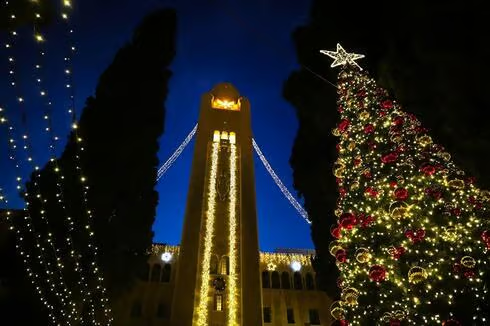
In Jerusalem, you can experience Christmas lights and decorations at the YMCA building, throughout the Christian Quarter, and in churches across the city.
As in previous years, I will be guiding Christmas-themed tours for Israelis.
Most Israelis have limited knowledge of Christianity and Christian culture. These tours aim to provide insight into the holiday’s origins, traditions, and meanings.
If you’re around — join us.
(Below: a nighttime photo of the beautifully lit YMCA building in Jerusalem.) Holiday Wishes
Warm December holiday wishes to my Jewish and Christian friends.
We are still waiting for a modern Hanukkah miracle — and for the safe return of the last hostage.
I hope to stay in touch and see you soon, either in Israel or in the U.S.
If you have family or friends planning a visit to Israel, I’d be grateful for a recommendation.
Merry Christmas