
Summer and vacation are almost behind us here in Israel, and on September 12–13, we’ll celebrate Rosh Hashanah—the Jewish New Year.
But here’s a question: When did Rosh Hashanah become the Jewish New Year?
I asked ChatGPT.
Its answer was wonderfully Jewish:
“It didn’t.”
Apparently, there isn’t just one “New Year” in Judaism. There are several, each serving a different purpose and falling on a different date.
So, in this very hot August newsletter, let’s take a little journey through Rosh Hashanah: where it comes from, why we celebrate it in Tishrei, why there are two days, Ashkenazi and Sephardi traditions—and, of course, food.
So come along.
And let’s catch that gefilte fish in the bathtub. 🙂
______________________________
So When Is the Jewish New Year?
The Torah actually calls Tishrei the seventh month.
The first month is Nisan, the month of Passover and the Exodus from Egypt:
“This month shall mark for you the beginning of the months; it shall be the first of the months of the year.”
— Exodus 12:2
So why are we celebrating New Year in the seventh month?
Because Judaism has never been particularly interested in having just one answer to anything.
The Mishnah, compiled around 200 CE, famously opens its discussion of Rosh Hashanah with:
“There are four New Years.”
There was a New Year for kings and festivals, one for tithing animals, one for agricultural purposes, and one for counting years, Sabbatical years, and other aspects of the agricultural calendar.
In other words, Nisan and Tishrei were both beginnings—but of different things.
Nisan
Nisan represents the beginning of Jewish historical time.
It is the month of the Exodus. The Jewish national story begins here.
Tishrei
Tishrei represents the beginning of the natural and agricultural year.
The harvest is ending. The rainy season is approaching. A new agricultural cycle is about to begin.
Over time, the first of Tishrei became Rosh Hashanah—the New Year for years, and eventually the New Year we know today.
So perhaps the better question isn’t:
“When did Rosh Hashanah move from Nisan to Tishrei?”
It is:
“When did Tishrei become the beginning of the year we celebrate?”
And the answer is: gradually, over the course of Jewish history.
______________________________
Why Two Days?
Here is another classic Jewish question:
Why do we celebrate Rosh Hashanah for two days?
The Torah doesn’t say to celebrate it for two days.
The answer takes us back to the ancient Jewish calendar.
Before the calendar was fixed, the beginning of each Hebrew month was determined by actually seeing the new moon.
Witnesses who had seen the new moon would travel to Jerusalem and testify before the Jewish authorities.
Was the month 29 days long?
Or 30?
Nobody had a calendar app to check.
So communities outside Jerusalem weren’t always sure exactly which day the holiday began.
The solution?
Celebrate for two days.
That way, you couldn’t really get it wrong.
Rosh Hashanah was particularly complicated because it begins on the first day of the month, when the moon is barely—or not at all—visible.
After the destruction of the Second Temple in 70 CE, the Jewish calendar was eventually fixed, making it possible to calculate the dates of Jewish holidays far into the future.
But Jewish tradition kept the two-day celebration.
And yes, this is also the reason many Jewish communities celebrate Passover for two nights.
______________________________
By the Rivers of Babylon
Rosh Hashanah also has a fascinating connection to the ancient Babylonian world.
After the destruction of the First Temple, Jewish life in Babylonia had a profound influence on the development of Judaism.
The very names of our Hebrew months come from Babylonian/Akkadian.
Tishrei is connected with the idea of beginning or opening.
Nisan is associated with spring, buds, and new growth.
The Jewish tradition surrounding Rosh Hashanah developed into something much bigger than simply celebrating another year.
It became a time of judgment, reflection, and hope.
According to Jewish tradition, on Rosh Hashanah:
God is crowned King.
God judges humanity.
Our fate for the coming year is written in the Book of Life.
Which is why the traditional greeting is:
Shanah Tovah U’Metukah — May you have a good and sweet year.
There are also many events that Jewish tradition connects with Rosh Hashanah: Sarah and Rachel becoming pregnant after years of infertility, Joseph’s release from prison in Egypt, and the Binding of Isaac.
Apparently, Rosh Hashanah is a very busy day in Jewish history.
Rosh Hashanah greeting from the United States.
______________________________
And, naturally, no Jewish holiday would be complete without food.
Among Ashkenazi Jews, one of the best-known traditions is apples dipped in honey, symbolizing the hope for a sweet new year.
But many Sephardi and Mizrahi Jewish communities have another wonderful tradition: the Rosh Hashanah Seder.
Yes—another Seder.
At the meal, a series of symbolic foods called simanim, or “signs,” are eaten. Each food represents a wish for the coming year.
The tradition goes back to the Babylonian Talmud and originally included several vegetables and fruits.
Over the centuries, Jewish communities around the world added their own foods and interpretations.
Today you might find:
Pomegranates, symbolizing abundance
Dates, representing sweetness
Leeks, associated with the hope that our enemies will be removed
Squash or pumpkin, representing good deeds and blessings
Fish, often associated with fertility, abundance, or the hope of being “the head and not the tail”
And, of course, apples and honey
Different Jewish communities have developed different versions of the ritual.
And that is one of the things I love about Judaism:
There is rarely one correct way to celebrate.
If you’d like to try a Rosh Hashanah Seder at home, here is a helpful guide from Reform Judaism:
What Goes on a Rosh Hashanah Seder Plate? – Reform Judaism
______________________________
From the Stomach to the Heart
After we’ve filled our stomachs, perhaps it’s time to fill our hearts.
Here is a simple activity you can try around your Rosh Hashanah table this year.
Read the short passage below, and then go around the table.
Ask everyone to answer one or both of these questions:
What is one positive thing you are taking with you from the past year?
What is one thing you hope to achieve, change, or experience in the coming year?
That’s it.
No long speeches.
And yes, I recommend asking the annoying uncle to keep his answer short. 🙂
______________________________
Rosh Hashanah: A Holiday About the Future
The Israeli educator Arieh Ben-Gurion once made an interesting distinction between the Jewish holidays.
Most Jewish holidays are holidays of memory.
On Passover, we remember the Exodus.
On Shavuot, we remember standing at Mount Sinai.
On Sukkot, we remember the Israelites wandering through the desert.
They ask us:
Where did I come from?
What is my story?
But Rosh Hashanah and Yom Kippur are different.
They don’t focus primarily on what happened in the past.
They ask:
Where am I going?
What kind of person do I want to become?
How do I want to live?
What is my dream?
What kind of family, community, and society do I want to help create?
And perhaps most importantly:
What can I do to make that future happen?
This is what makes Rosh Hashanah such an optimistic holiday.
It tells us that the future is not completely predetermined.
There is still time to change.
To grow.
To repair.
To begin again.
______________________________
So, What Is Rosh Hashanah Really About?
Rosh Hashanah is much more than a Jewish version of “Happy New Year.”
It sits at the fascinating intersection of nature, agriculture, history, time, memory, self-reflection, and hope.
It is about looking backward—but also, perhaps even more importantly, looking forward.
So as we enter the year 5787, I hope you have a year filled with good health, family, happiness, meaningful encounters—and maybe just a little less trauma involving live carp.
Shanah Tovah U’Metukah!
A very happy and sweet New Year from Israel,
Hilik
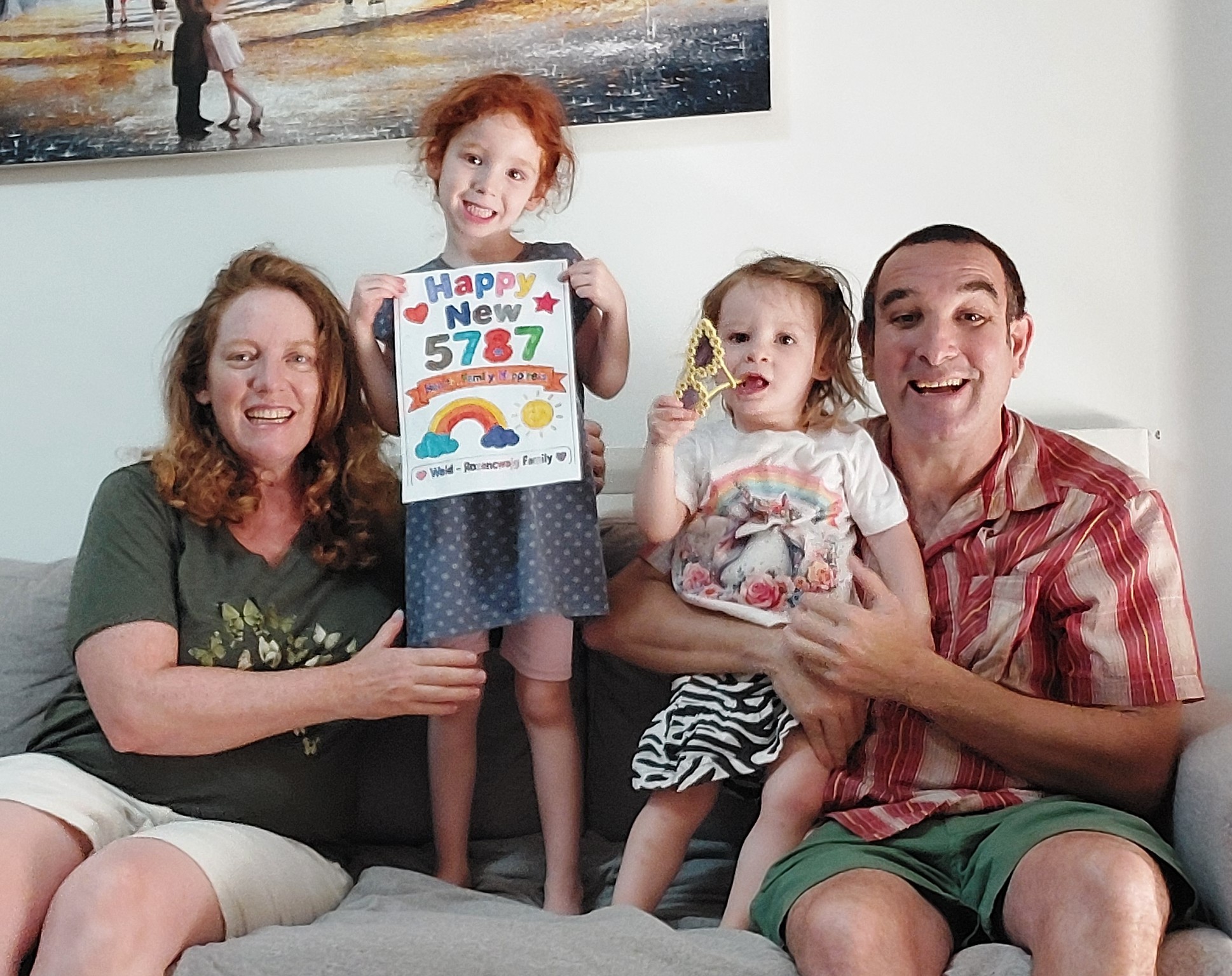
P.S. — A picture of the Wald–Rozencwajg family Rosh Hashanah greeting from the United States.