
Dear friends,
I’m happy to be back “after the holidays” and writing to you again — a little later than planned!
My family and I recently spent some time in Hungary, and I came back very impressed: clean, orderly, affordable, and full of history. I was especially fascinated by Budapest’s magnificent Great Synagogue, where Theodor Herzl celebrated his Bar Mitzvah.
But now, back to Israel.
On October 27, Israelis will go to the polls for the country’s 2026 Knesset elections. I recently gave a Zoom talk about the elections to a group of professionals from the Boston area — mostly Jewish, along with some non-Jewish Americans and Israelis.
Joe, thank you for the opportunity — and stay healthy!
What follows is some of what I shared with them.
________________________________
This Election Is About More Than Netanyahu
Israel is supposed to hold parliamentary elections every four years. In reality, Israeli governments have often collapsed long before completing a full term.
The current Knesset, elected in November 2022, is unusual: it actually reached the end of its four-year term.
Turnout in 2022 was 70.6 percent — considerably higher than American congressional election turnout in many recent elections.
But the interesting question this time isn’t simply who will win.
For me, the bigger question is:
What kind of Israel do we want?
More liberal or more conservative?
More secular or more religious?
What should the relationship between religion and state look like?
And, perhaps most importantly:
Can Israel remain both Jewish and democratic — and what does that actually mean?
________________________________
The “Right-Wing Dream” Government
The current government is widely described as the most right-wing government in Israel’s history.
In Israel, it was sometimes called “Right, full steam ahead” — Yamin al-Maleh.
For the first time in many years, there was no centrist or left-wing party inside the governing coalition.
In previous governments, the right could sometimes say: We would have implemented our agenda, but our coalition partners stopped us.
This time, there was no one else to blame.
If I were a committed right-wing voter, I might have expected these four years to be a dream come true:
A right-wing government.
A right-wing prime minister.
A sympathetic American administration.
Major changes to Israel’s judicial system.
And, for some on the right, movement toward extending Israeli sovereignty over parts of the West Bank.
Instead, the last four years have been extraordinarily turbulent.
Israel has been fighting on multiple fronts — Iran, Syria, Lebanon, Gaza and the West Bank.
And yet there has been no simple military victory and no clear diplomatic resolution.
That is particularly frustrating for Israelis because our traditional security doctrine has emphasized short wars, clear military achievements, and then diplomacy.
This time, many Israelis feel stuck between the two:
No decisive military conclusion.
No diplomatic settlement.
The judicial overhaul was not completed as originally envisioned, and the government has still not resolved the long-running dispute over Haredi military service.
And then came the event that changed everything:
October 7, 2023.
Whatever your politics, it is impossible to understand Israeli politics today without October 7.
________________________________
Israel and America: Same Democracy, Different Game
Israel and the United States are both democracies, but our political systems are very different.
Israel has one national electoral district. We don’t vote for a local member of Congress.
We vote for a party.
There is no separate national election for president. The head of government is the prime minister.
And Israel has a multi-party system.
This means that instead of choosing between two large parties, Israelis can choose from a long list of political options.
You can vote for a right-wing party, a secular party, a religious party, an economically liberal party, a socialist party, an Arab party — or a brand-new political movement.
This creates enormous political freedom.
It also creates enormous political fragmentation.
________________________________
The Israeli Version of “Trump or Not Trump”
And here is where things get particularly interesting.
Despite Israel’s multi-party system, the central question in this election is still:
Bibi or not Bibi?
It sometimes reminds me of the American question of Trump or not Trump.
In my view, Netanyahu represents an Israeli version of a broader political phenomenon often referred to as Trumpism — a style of politics that has appeared in different forms around the world.
But there is an important Israeli twist.
Netanyahu has organized politics around blocs.
There is the Netanyahu bloc — broadly right-wing, religious and conservative.
And there is the anti-Netanyahu or “change” bloc — a collection of parties with very different political views, united primarily by the desire to replace him.
That creates some fascinating political contradictions.
Imagine a new party that describes itself as right-wing, calls for a state commission of inquiry into October 7, has no one who held a major national-security position on October 7, and places an Arab Christian candidate second on its list.
You might expect journalists to ask:
“What does this party believe about religion and state?”
“What is its economic policy?”
“What is its position on the Palestinians?”
Instead, the question is:
“Are you with Bibi or against Bibi?”
That question can overshadow almost everything else.
________________________________
The Change Bloc: United by What It Opposes
The parties in the anti-Netanyahu bloc disagree about many things.
They disagree about the Palestinians.
They disagree about religion and state.
They disagree about economic policy.
They disagree about settlements.
What unites them is more limited:
Replace Netanyahu.
Stop or reverse parts of the judicial and constitutional changes.
Address the question of military service for Haredim.
One of the most interesting figures in this camp is former IDF Chief of Staff Gadi Eisenkot.
Eisenkot presents a different political profile from many previous leaders of the center-left camp.
His parents immigrated from Morocco, making him Mizrahi.
He has an extensive military and security background.
And, tragically, he lost his son Gal, a reservist, during the war in December 2023.
That gives him a deeply personal connection to the war and to the families who have paid the ultimate price.
Identity matters in Israeli politics.
For years, the Israeli right has presented itself as the political home of many Mizrahi Israelis, even though the Likud has never had a Mizrahi prime minister.
Eisenkot potentially makes it easier for some traditionally right-wing voters to consider crossing the political divide.
And this is particularly important because many voters in the anti-Netanyahu camp are not voting primarily on ideology.
They are voting strategically.
Their question is not necessarily:
“Who do I like?”
It is:
“Who has the best chance of replacing Netanyahu?”

Gadi and Gal Z”L Eisenkot
________________________________________________________
Arab Israelis: A Story Worth Watching
Arab citizens make up roughly 21 percent of Israel’s population, but voter turnout among Arab citizens has traditionally been lower than the national average.
In the 2022 election, turnout in Arab communities was about 53 percent.
That has political consequences.
Arab parties have also frequently been divided among themselves.
But this election contains some interesting developments.
One is the continued political evolution of Ra’am, led by Mansour Abbas.
Abbas already broke an important political taboo when his party joined an Israeli governing coalition.
Ra’am has emphasized integration into Israeli society and practical issues affecting Arab citizens.
One of its proposals is some form of national service for Arab citizens beginning at age 18.
If such a policy were ever implemented successfully, it would represent an important shift:
Not only rights, but responsibilities.
Another unusual development is Abbas’s decision to place Jewish former senior police officer Yoav Segalovich high on the party’s list.
A Jewish candidate on an Arab party’s list.
At the same time, another new party has placed an Arab Christian candidate high on a predominantly Jewish party list.
These may seem like small details.
I don’t think they are.
They tell us something about how Israeli political identities are becoming more complicated.
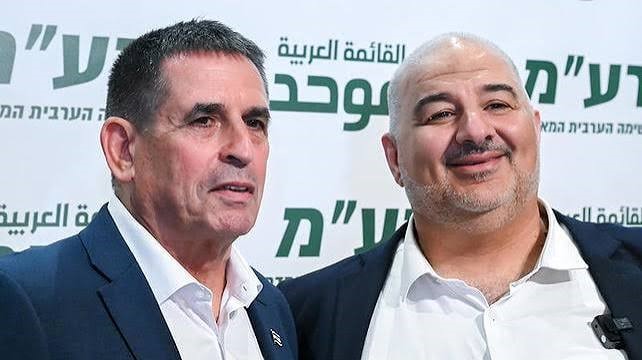
Mansur Abas (right) and Yuav Segalovitz (left)
_____________________________________________________
And Then There Is Balad
Another important story involves Balad, an Arab political party.
The Supreme Court recently considered a petition seeking to prevent Balad leader Sami Abu Shehadeh from running in the election.
The petition focused on statements he made after October 7 and whether they constituted support for armed struggle against Israel.
The court ultimately barred Abu Shehadeh personally from running, while allowing Balad itself to participate.
This is one of the difficult questions Israeli democracy continues to wrestle with:
Where does legitimate political opposition end, and support for undermining the state begin?
There are no easy answers.
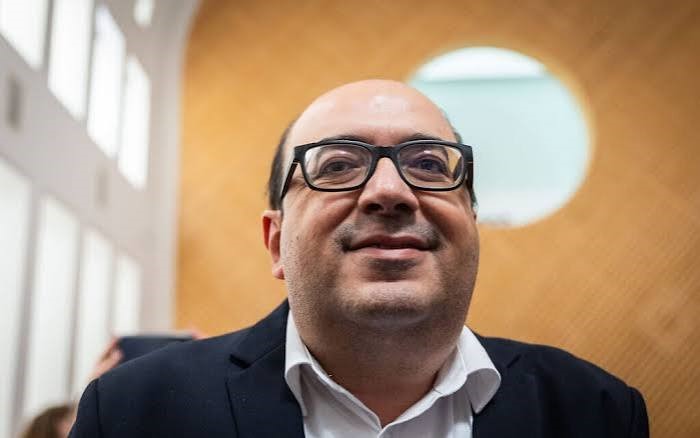
Sami Abi Shehadeh.
So… Who Is Winning?The honest answer is:
We don’t know.
Recent polls have shown a very fragmented political map, with different surveys giving different results. Neither side has consistently demonstrated a clear path to the 61 Knesset seats required to form a government.
And this leads to perhaps the most interesting question of all:
Are the parties in the anti-Netanyahu camp willing to rely on Arab parties or Arab support to form a government?
If not, the numbers become very complicated.
Israel has 120 Knesset seats.
You need 61 to form a government.
And if neither political bloc can reach that number, Israel could once again find itself in political deadlock.
Which brings me to Shimon Peres.
________________________________
“Polls Are Like Perfume”
Shimon Peres once said:
“Polls are like perfume: you can smell them, but you shouldn’t drink them.”
Peres spent almost his entire adult life in politics.
He lost many elections and leadership contests.
There was even a joke that he couldn’t win an election for his apartment building’s homeowners’ committee.
Peres himself had a wonderfully painful line about his relationship with the polls:
“I am the prime minister of the polls, and someone else is the prime minister of the results.”
So I try to remember that when I look at today’s polls.
And then there is Benjamin Netanyahu.
Can anyone really count him out?
He has been Israel’s longest-serving prime minister and has won more national elections than any other Israeli politician.
Whatever happens on October 27, the polls are not going to tell us the ending.
________________________________
The Question That Stayed With Me
At the end of my Zoom presentation, there was time for questions.
One comment really stayed with me.
An Israeli doctor said that he believed Israel might cease to exist within twenty years because the country would destroy itself from within.
I found that deeply troubling.
Not only because of the prediction itself, but because it raised two questions I cannot easily answer.
Is this becoming a common feeling among American Jews?
And:
Could I continue to live as a Jew without the State of Israel?
My honest answer to the second question is no.
Israel is not simply the country where I live.
It is part of how I understand Jewish history, Jewish identity and Jewish life.
That is why the current moment is so painful.
________________________________
Can the Israel–American Jewish Relationship Heal?
There is another question that troubles me.
Can the growing divide between liberal American Jews and the State of Israel be repaired if Israel’s government changes?
Or has something deeper happened?
Will American Jews and Israelis remain close, connected and supportive after these turbulent years?
Or has something fundamental changed?
I don’t know.
And perhaps that’s okay.
Some questions are more important when we continue asking them than when we rush to find an answer.
________________________________
Come Visit Israel
And finally, some good news.
American tourism to Israel is beginning to return after a long period of disruption. American airlines are returning, and the tourism industry is slowly waking up again.
If you, your family or your friends are thinking about visiting Israel, I would love to show you around.
Not just the famous places.
I want to show you the Israel behind the headlines:
The history.
The people.
The arguments.
The humor.
The contradictions.
And the everyday life that you simply cannot understand from a news report.
This newsletter is really an invitation to continue the conversation.
If you would like to organize a private or group discussion about Israel, the 2026 election, Israeli society, or the relationship between Israel and American Jewry, I would be very happy to talk, listen and exchange ideas.
Until next time,
Hilik